
🔴 This [TRADE] has attracted a large amount of capital over the last years
February 25, 2026 >> The idea is to monetize diversification and low correlations

🎥 → LIVE Global Macro Strategy Summit (Dec 12-13, 2026)
EARLY-BIRD is LIVE for a limited time
🔐 Bonus: your ticket price is credited toward Macro Mornings PRO
📆 Full Agenda & Speakers → here
👉 Build your 2027 cross-asset playbook with Featured Guest Speakers.

🎟️ PRO PASS (Most Popular) → $49 (then $79)
🎫 VIP PASS (For serious builders) → $149 (then $249)
🆓 FREE PASS (limited access) here

Dear Investor,
Most investors are looking at the headlines.
Very few are looking at the structure underneath them.
And right now, that structure is where the real story is.
Over the last few weeks, I’ve gone back to the same charts repeatedly - not because I needed more confirmation, but because the message became impossible to ignore once I stopped reading them individually and started reading them as one connected signal.
What I’m seeing is not just another macro update.
It’s a market that still looks strong on the surface - while, underneath, capital is crowding into the same trades, correlations are being monetized aggressively, liquidity is doing the heavy lifting, and fragility is quietly building in places most investors are not watching.
That combination is exactly where PRO investors below can gain an edge.
Because this isn’t the type of market that rewards people who only follow price after the move. It rewards those who can identify where the pressure is building before it becomes obvious, where liquidity is masking risk, and where market structure can amplify the next rotation.
So in this note, I’m not giving you 10 disconnected chart comments.
I’m giving you a single macro narrative, so you can see how valuation, Fed tone, liquidity, funding stress, labor-market shifts, FX dynamics, and volatility positioning are interacting right now - and what that likely means for positioning in the weeks ahead.
If you read this carefully, you won’t just understand what happened.
You’ll understand what the market may be underpricing next.
📈 The hidden cost of expensive confidence
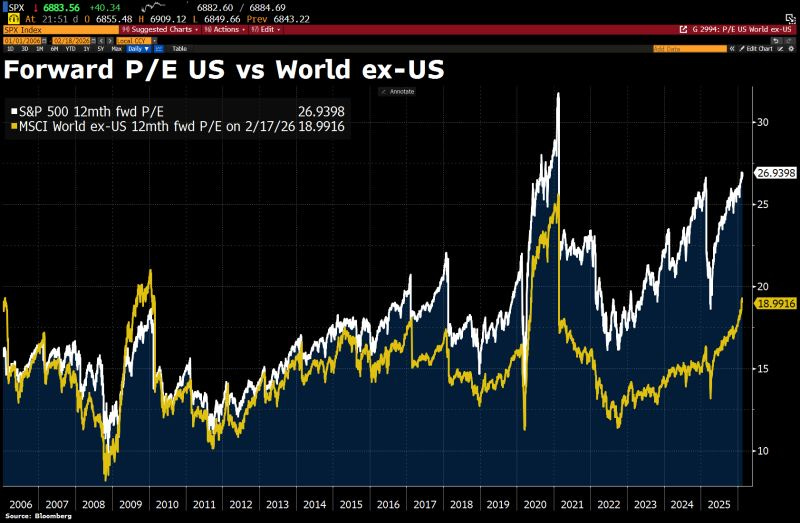
I want to begin with the chart on Forward P/E US vs World ex-US, because valuation is where the market reveals what it believes deserves trust.
The latest readings are striking: the S&P 500 is trading at roughly 26.9x forward earnings, while MSCI World ex-US is closer to 19.0x. That still leaves US equities at about a 40% - 42% valuation premium to the rest of the world.
Yes, global markets have narrowed the gap in recent weeks, and yes, that matters.
But I think we need to be very honest about the starting point: a premium of this size isn’t just a growth premium.
It is a confidence premium. Investors are paying up not only for earnings power, but for perceived business quality, visibility, scalability, and the belief that the dominant US leadership cohort - especially big tech - should continue to command structurally higher multiples than almost everything else.
That may continue. But when a market trades at this kind of premium, it also becomes much less forgiving. The market no longer needs a collapse to reprice.
It only needs the story to become slightly less perfect.
And this is where the capex question becomes central. If large technology companies continue increasing capex aggressively to defend AI leadership, infrastructure, and distribution advantages, they may still grow, they may still dominate, and they may still remain outstanding businesses.
But investors may gradually start valuing more of that leadership cohort less like pure capital-light software franchises and more like capital-intensive compounders. That doesn’t kill the bull case. It changes the multiple framework.
Personally I don’t think the US premium needs to crash for this to matter. If the premium simply compresses from roughly 40% toward 25%-30% - still elevated, still a premium - the consequences could be meaningful. We could see a phase where international equities outperform on a relative basis even if US indices keep rising. Or we could see a broader US index de-rating if earnings revisions are not strong enough to carry the weight of current multiples.
When I think about history, I keep coming back to 2003-2007, when non-US equities materially outperformed in a more globally synchronized cyclical expansion.
That doesn’t mean we are repeating that exact period. It means valuation spreads this wide have a habit of becoming less stable once growth broadens beyond the most expensive leadership pocket.
On the other hand, 2023-2025 showed the opposite dynamic, with US leadership extending and the premium widening further as investors paid aggressively for quality, scale, and AI leverage.
The lesson for me is not that valuation tells us timing. It rarely does in the short run. The lesson is that valuation changes the distribution of outcomes. The bigger the premium becomes, the more the market needs reality to keep validating it, and the more vulnerable relative performance becomes if the narrative loses even a little momentum.
This is also why I’m paying attention to real yields in the same breath.
US real yields and long-duration equity multiples tend to move with a negative relationship. That matters much more when the S&P is trading at 26x-27x forward earnings than when it is trading at 16x-18x.
When valuations are already high, a small move in discount rates can have a disproportionately large effect on sentiment and leadership.
And while that valuation story is unfolding, the Fed enters the picture - not as a clean directional driver, but as the force that shapes how much room the market has to keep telling itself a smooth macro story.
The FOMC sentiment chart captures this shift beautifully.
The tone in the January minutes wasn’t a full hawkish pivot, and it wasn’t panic. To me, it was something more subtle and more important: the Fed signaling that the path to durably achieving 2% inflation could be slower and more uneven than the market’s most optimistic assumptions.
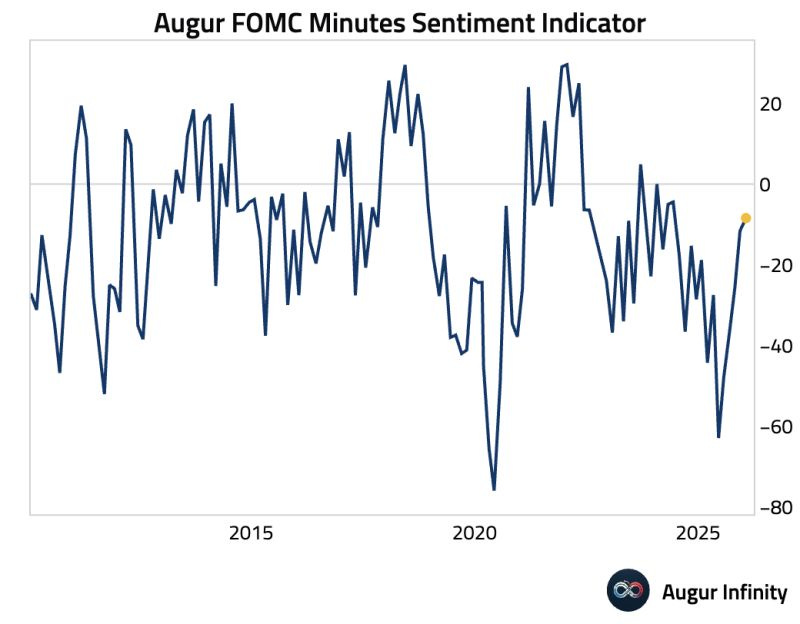
That is the “last mile” problem.
The first phase of disinflation is usually easier. Base effects help. Goods normalize. Supply chains heal. The later phase is where the process becomes messy: shelter, wages, policy frictions, tariff effects, and expectations start to matter more. Markets want a clean line. Central banks are warning us the line may look more like a staircase.
Even if the policy rate stays in the 3.5%-3.75% range for now, I think the more important issue is the reaction function.
If inflation proves sticky in the wrong categories while growth stays resilient, markets may have to keep repricing the probability and timing of cuts.
If growth weakens faster, cuts may come - but under a softer earnings backdrop, where rate relief is partly offset by growth anxiety. That is why I keep repeating this to myself and to you: cuts aren’t automatically bullish; the reason behind the cut matters more than the cut itself.
We have seen versions of this before. In 1994, in 2018, and in several windows across 2021-2024, periods of hawkish repricing or “last-mile” inflation anxiety often produced a familiar cross-asset pattern: 2-year Treasury yields repriced higher, duration-sensitive equities came under pressure, and the dollar firmed.
In practice, the market doesn’t need a dramatic shock. A 10-25 bps move in the 2-year Treasury yield over a few sessions can be enough to trigger multiple compression in growth-heavy sectors when positioning is extended.
This is where cross-asset correlation helps us think clearly. Hawkish Fed repricing tends to correlate positively with front-end yields, often positively with DXY, and negatively with long-duration equity multiples. When those relationships begin moving together, markets can reprice much faster than the headlines suggest.
And yet - this is the key point - the market has remained resilient. Why? Because the next chart answers that question in one line.
Global liquidity.
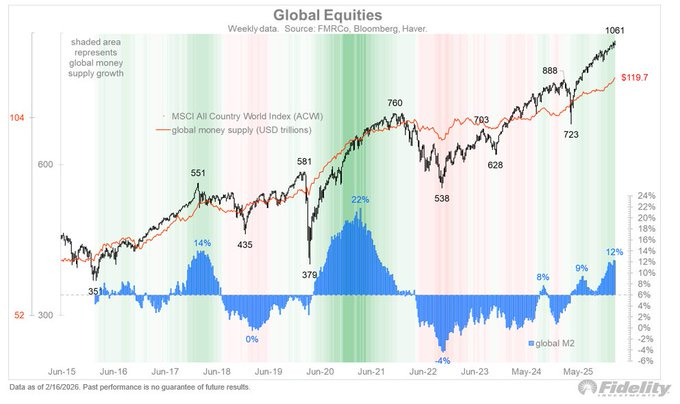
The chart below showing global money supply and global equities is, in my view, the bridge between “why valuations look stretched” and “why prices still keep getting support.”
Global money supply is now around $120 trillion and growing at approximately a 12% pace. When I look at that, I don’t find risk-asset resilience surprising. I find it logical.
Liquidity is not the only driver of markets, but it is often the most underappreciated driver in the short and medium term.
When liquidity is improving and financial conditions are not restrictive enough to create broad stress, markets can stay expensive longer than many valuation-based frameworks expect. That doesn’t make valuation irrelevant. It just means liquidity can dominate the timing.
The historical pattern in that chart is familiar and incredibly useful.
When global money supply growth turns positive and accelerates, equities tend to respond with a lag.
When liquidity growth fades, markets become more vulnerable to de-rating, spread widening, and correlation shocks. I think this is why so many investors feel intellectually “right” but operationally early in liquidity driven regimes.
The clearest modern example remains 2020-2021. Global liquidity accelerated sharply, and global equities staged one of the strongest rebounds in modern history from the pandemic lows.
By contrast, 2022 brought tighter conditions, weaker liquidity momentum, and a broad drawdown in global risk assets, including a meaningful decline in MSCI ACWI. The lesson isn’t that liquidity explains every move. The lesson is that it powerfully shapes the environment in which other variables matter.
And this relationship often works through lagged correlation, not same-day reactions.
I don’t expect ACWI to move in lockstep with each weekly liquidity estimate. I expect liquidity trends to shape the background conditions that determine whether dips are shallow or deep, whether spreads widen briefly or persistently, and whether leadership broadens or narrows.
So yes, I still see support for risk assets here. As long as global liquidity growth remains in the high single digits to low double digits, something like 8% - 12%, the market can keep finding buyers on weakness.
But when liquidity is carrying more of the burden, it also means we have to watch very closely for the places where the system is quietly telling us that the underlying plumbing is becoming less comfortable.
🏦 The currencies that move before equities do
The Standing Repo Facility chart is the kind of chart I never treat as a footnote, even when the immediate explanation looks benign.
Demand for the Fed’s SRF surged to $30.5 billion, the 4th-largest operation since the 2020 pandemic, split between roughly $18.5 billion in Treasuries and $12.0 billion in MBS.
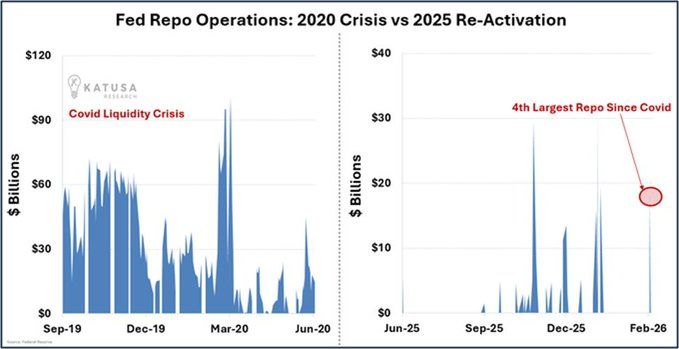
The calendar-squeeze explanation is plausible. Holiday-related settlement timing can absolutely create these distortions. We’ve seen similar patterns around quarter-end, year-end, and other balance-sheet-sensitive dates.
But the reason I pay attention is simple: repo markets are often where stress first appears, not where it first becomes obvious.
A one-off spike is a data point. I treat it that way. But repeated spikes outside obvious calendar squeezes become a pattern, and once it becomes a pattern, I stop asking “is this technical noise?” and start asking “what balance-sheet constraint is the market trying to signal?”
That is why September 2019 still matters to me.
It reminded everyone that front-end funding markets can force a policy response faster than most macro narratives anticipate.
Then March 2020 gave us the extreme version, when funding stress, equity liquidation, and Treasury market dysfunction collided at the same time. I’m not saying we are reliving those moments.
I’m saying the function of the signal remains the same: persistent funding stress tends to correlate with higher front-end volatility, greater sensitivity in rate markets, and a more fragile backdrop for risk assets.
There is a cross-asset rhythm here that I always watch. If funding stress persists, we often see signs of tighter dollar liquidity, weakness in funding-sensitive segments, and more fragile relative performance in areas like small caps and financials.
Not every repo spike causes that chain reaction - but when it starts, the chain reaction is usually visible in funding proxies and rate volatility before it is obvious in the S&P 500 headline.
At the same time, while the market is trying to read funding conditions, it’s also trying to read the labor market with outdated heuristics - and I think that is creating a lot of unnecessary confusion.
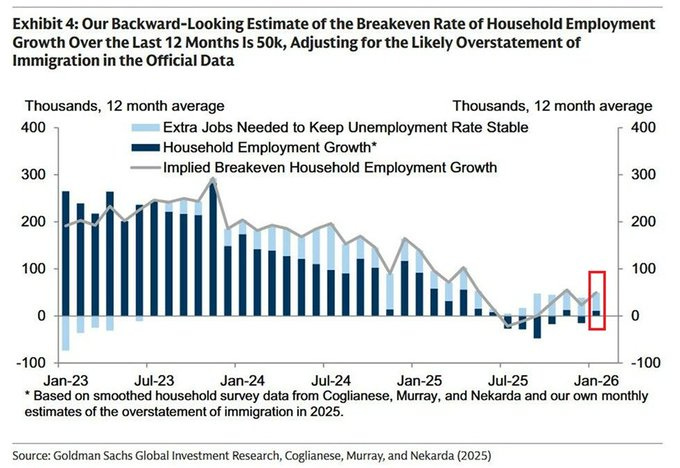
The labor-market breakeven chart may be one of the most important charts in the whole package because it changes how we should interpret payroll data.
The estimated breakeven rate of household employment growth needed to keep unemployment stable has fallen to roughly 50,000 jobs per month, down from roughly 200,000-250,000 in 2023. That is a collapse of around 75%-80% in the breakeven threshold.
That isn’t a small adjustment. That is a structural shift.
If labor force growth is slowing - and falling immigration is one major reason - then the economy simply doesn’t need the same monthly job creation to keep unemployment from rising. That means job growth can look soft by old standards while still being consistent with a relatively stable labor-market equilibrium.
This helps explain something that would have confused many investors using older frameworks: periods in mid-2025 where household employment growth was weak or near zero, yet unemployment remained relatively stable. If we keep applying old thresholds to a changed labor-force regime, we’ll keep mislabeling recalibration as deterioration.
I’ve seen this in markets before, across other macro series. Investors become anchored to a number because it worked for a previous regime, then the underlying structure changes and that number loses explanatory power.
I think payroll interpretation is moving into that category. The old reflex - “sub-150k payroll equals immediate growth scare” - has become much less reliable unless it’s confirmed by unemployment, wages, hours worked, and participation.
History supports that nuance. In slower labor-force-growth periods, including parts of 2017-2019, payroll numbers that looked only moderate by previous standards were still consistent with stable unemployment and supportive risk-asset performance.
In faster labor-force-growth regimes, similar numbers would have been more concerning. The difference was not sentiment. It was the structure of the labor supply dynamic.
This is why I now care more about the correlation cluster around labor data than the payroll print in isolation. If payroll is soft but unemployment is stable, hours worked aren’t collapsing, and wage pressures remain sticky, the market’s reaction in yields can be very different from what many expect.
On the other hand, if we start seeing a rise in unemployment, weaker hours, softer wage growth, and declining participation together, the signal becomes much more powerful.
And this is where the global story widens, because while investors are recalibrating labor-market thresholds and watching repo usage, the currency market is already repricing policy uncertainty - starting with the yen.
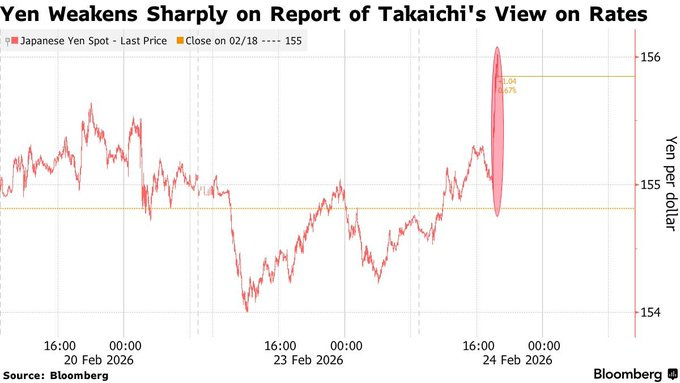
The yen chart is a reminder that FX often moves first.
The yen weakened sharply after reports that Prime Minister Sanae Takaichi opposed further BoJ rate hikes in discussions with Governor Kazuo Ueda, with the move reaching about -1.0% versus the US dollar and leaving the yen as the weakest performer among G10 peers in that session.
At the same time, the market was pricing only around a 59% chance of a BoJ hike by the April meeting, with a full 25bp move not fully priced until around July.
I don’t read this as just a Japan story.
I read it as a global macro signal because the yen sits at the heart of funding conditions, carry trades, and cross-border positioning.
In the short run, yen weakness can support risk appetite by reinforcing delayed BoJ normalization and easier funding assumptions. But that same move can also build fragility if it becomes too consensus and investors start treating it as a one-way trade.
This is one of the paradoxes of macro: a move can support markets and increase future risk at the same time.
The 2022 experience still offers a strong reference point.
As US-Japan yield differentials widened, USD/JPY rose sharply, the yen weakened toward multi-decade lows, and Japanese exporters benefited from the translation effect.
But the same setup also made the system highly sensitive to policy rhetoric, intervention risk, and rate repricing. When yen reversals come in risk-off windows, they often come faster and harder than equity investors expect.
That is why I treat the yen as a macro pressure gauge, not just a currency pair.
USD/JPY tends to track yield differentials, yen weakness can support exporter-heavy Japanese equities, and abrupt yen strength during risk-off periods often correlates with pressure on carry and broader risk assets.
The signal is rarely isolated.
And once we move from the direction of the yen to the scale of yen-linked funding, the story becomes even more important.
⭐️ This is a paid content, so scroll to read it…[🎁 #7 BONUS if you become a PRO today]
If you’re a PRO subscriber, make sure you’re logged in to access the full piece.
If you’re still a FREE reader, you have exclusive options to unlock this special edition and all past PRO content.
🗣️ Read what others say about us. TrustPilot - Don’t take my word for it.
🎁 Special Today - 7 bonuses if you become a PRO (FREE)👇
(These bonuses alone are worth more than the subscription.)
🎁 BONUS #1 - Price Locked Forever (you’ll never pay more)
🎁 BONUS #2 - Monthly Live Mastermind (value: $1,197/year)
🎁 BONUS #3 - Full App Access: all exclusive content, anytime, anywhere
🎁 BONUS #4 - Private Community Access: the Macro Mornings Family
🎁 BONUS #5 - Premium charts + Macro Asset Dashboard (FREE version)
🎁 BONUS #6 - Full access to 650+ advanced research analysis
🎁 BONUS #7 - Free copy of my book “51 macro strategies”
🚨 February 2026 Flash Sale
✅ Macro Mornings PRO (Save 40% forever)
Only 5 spots left → FROM $570/year TO $342/yr (or $29/month)
✅👑 Lifetime (Best value)
Only 6 spots left → FROM $1,140 TO $798 one-time (or $13/month)
👉 After payment, you’ll receive a Welcome Kit by email with all the material and instructions to join.
2. 👉 Or start your 7-day FREE Trial - exploring only the PRO analyses without any risk. [Click here]
Keep reading with a 7-day free trial
Subscribe to Macro Mornings 💡 to keep reading this post and get 7 days of free access to the full post archives.