
🟡 [THE TRILLION] Everyone Counted the Inflows. I Sat Down and Counted What Comes Next...
June 6, 2026 >>> The one quiet number that just flipped from cuts to hikes



Dear Investors,
The whole world saw the same headline I did last night. VOO is the first ETF in history to cross $1 trillion.
And the whole world celebrated the wrong number.
Within an hour my phone was a fireworks display - rocket emojis, screenshots, two people sending me the same chart captioned “the machine that can’t be stopped.” For the length of a coffee, I let myself enjoy it too.
Then I did what I always do when a number gets this loud. I printed the charts, cleared the desk, and laid them out in the order they had reached me.
The $1 trillion print isn’t the story. It’s the symptom. The real story was hiding 3 charts deeper - in a single line on a swaps curve that almost nobody is watching, a number that has quietly flipped from cuts to hikes while everyone stared at the fireworks.
The last 2 times the market moved the way it’s moving right now? One of them was a recovery. The other was weeks before the worst day in stock-market history.
I’m not going to tell you which one we’re in. I’m going to show you - with the receipts. What stocks, bonds and currencies actually did the last time the picture looked exactly like this.
Because opinions are cheap. And the only memory the market truly respects is the memory of price.
💰 The first trillion-dollar fund - and who really built it
VOO has pulled in +$69 billion of fresh money in 2026 already, on pace for its largest annual haul since the fund was born in 2010.
And that follows +$118 billion in 2024 and +$138 billion in 2025. Since the 2022 bear-market bottom, this single fund’s assets have more than tripled.
Its rivals haven’t withered - IVV now sits near $860 billion, SPY near $785 billion - but VOO broke the tape first.
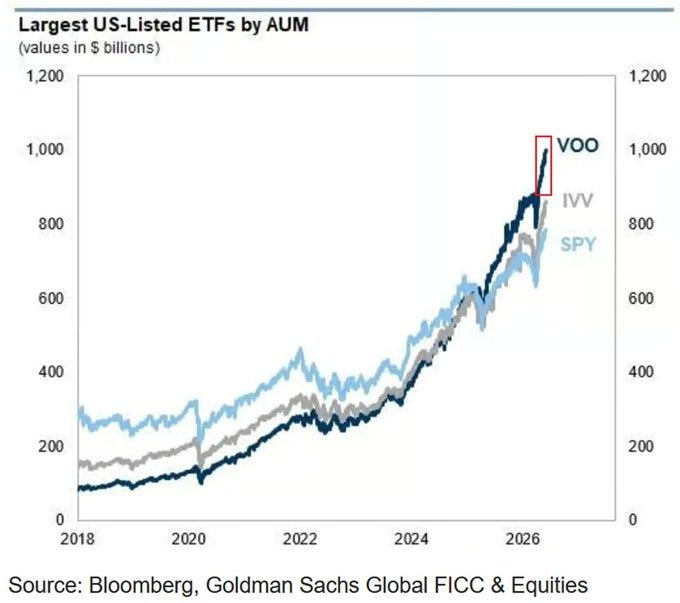
Zoom out, and the scale is hard to hold in your head. Global ETF assets reached $21.9 trillion by the end of April, more than 3 times the $6.4 trillion of early 2020, after an unbroken 83 consecutive months of inflows.
A trillion-dollar index fund is not a vote of confidence in any company - it is a vote of confidence in the act of not choosing.
Every dollar that lands in VOO is spread across all 500 names by size, with no opinion about whether any of them is cheap or doomed. On the way up, that indifference is a gift. The trouble is that indifference cuts both ways.
So I reached back for the record, and it offered no comfort. Record inflow years have a cruel habit of arriving at the worst moment. The crowd poured money into equity funds at a record clip into the 2000 top, and again in 2021.
And what came next was not more of the same. In 2022 the S&P 500 fell -19.4% and the Nasdaq dropped -33%, its worst year since 2008.
The correlation is uncomfortable precisely because it is mechanical, not emotional: peak annual inflows move inversely to the following year’s returns.
The same plumbing that makes passive money a relentless, price-blind bid on the way up turns it into a relentless seller the instant flows reverse. The redemptions simply arrive, and the machine sells what it must, without sentiment.
That is how a melt-up quietly becomes an air pocket.
🌍 The owners of the market have quietly changed
The second chart explains the first, and it is the one that made me put the coffee down.
Foreign investors now hold a record $20 trillion of US stocks - about 19% of the market - a share that has nearly tripled since 2000.
Passive funds and ETFs hold $17 trillion, roughly 15%, triple their share since the 2008 crisis. And the group that paid for it? Active mutual funds, whose weight has more than halved to $11 trillion, around 10% - the lowest since the early 1990s.
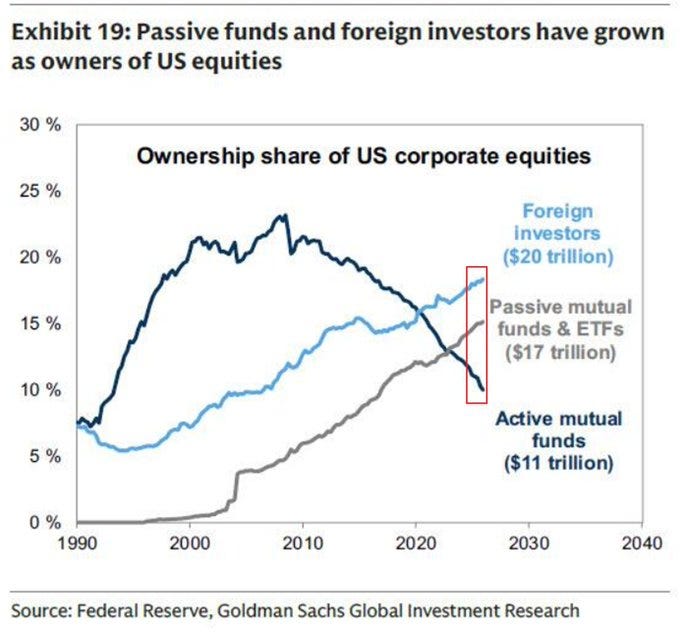
The two fastest-growing owners of corporate America are foreigners and passive vehicles - the two groups least tethered to American fundamentals and to price discipline.
Foreign capital chases relative performance and a strong dollar. Passive capital chases nothing at all. And the one constituency that used to lean against excess - the active manager, paid to sell the overpriced and buy the forgotten - is shrinking out of relevance.
Here, history keeps its record in the currency, not the index. The foreign bid breathes through the dollar.
In 2022 the Dollar Index surged roughly +19% to around 114, a 20-year high - and that strength quietly masked the equity losses for overseas holders, who earned on the currency even as the stocks fell.
The danger is the reverse. When the dollar turns, a foreign investor….
⭐️ Join 54,000+ investors who chose Macro Mornings PRO.
Two simple paths below - Yearly to begin, Lifetime to never look back.
[🎁 #7 BONUS if you become a PRO today]


Keep reading with a 7-day free trial
Subscribe to Macro Mornings 💡 to keep reading this post and get 7 days of free access to the full post archives.