
🤯 The most important MACRO divergences is shown below
February 19, 2026 >> History is doing what it always does

🎥 → LIVE Global Macro Strategy Summit (Dec 12-13, 2026)
EARLY-BIRD is LIVE for a limited time
🔐 Bonus: your ticket price is credited toward Macro Mornings PRO
📆 Full Agenda & Speakers → here
👉 Build your 2027 cross-asset playbook with Featured Guest Speakers.

🎟️ PRO PASS (Most Popular) → $49 (then $79)
🎫 VIP PASS (For serious builders) → $149 (then $249)
🆓 FREE PASS (limited access) here

Dear Investor,
There are mornings when one single print doesn’t just move markets - it reveals them.
You can literally watch the narrative flip in real time: screens go from tense to euphoric, talking heads suddenly sound “certain,” and the phrase “soft landing” stops being a hypothesis and becomes a shared belief.
February 19, 2026 is one of those mornings.
But here’s the part most investors will miss - and the part you can’t afford to miss if you’re reading this as a PRO. Because the real story isn’t the CPI headline.
The real story is the divergence sitting underneath it - the kind that only shows up a few times per cycle, right before leadership changes and portfolios get repriced.
History is doing what it always does.
It’s leaving clues in the data while most people celebrate the surface.
So I’m going to show you all my analyses through the charts and considerations below, keeping every number intact - but I’ll connect them the way the market actually works: what cooled, who is absorbing the pressure, and where capital is already rotating before it becomes obvious.
My goal isn’t just to inform you. It’s to make sure you feel the regime shift while it’s still early - because once everyone agrees on it, the opportunity is usually gone.
✈️ The Print, the Relief, and the Last Mile
The headline was a gift to risk assets.
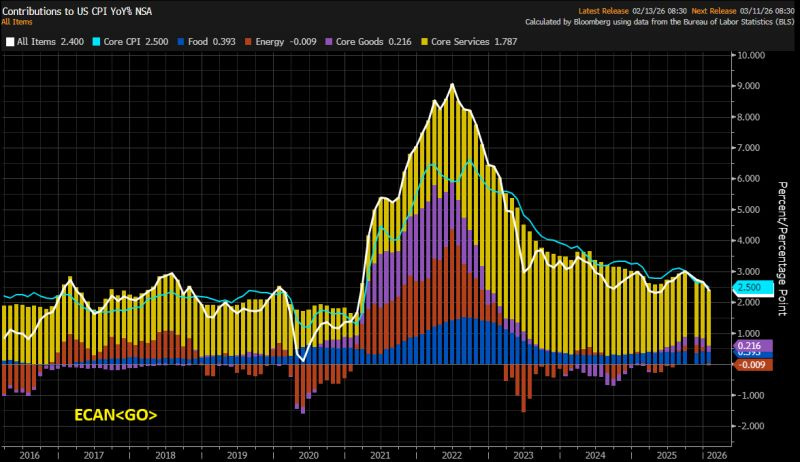
Headline inflation printed at 2.4% YoY against an expectation of 2.5% - the lowest since May - while Core inflation came in at 2.5% YoY, the slowest pace since March 2021.
After the “hot” jobs report earlier in the week, this was the kind of release that makes the market exhale.
And yet, when I stare at the decomposition, I don’t see a finish line. I see a final stretch.
The chart makes the composition crystal clear.
Core services are still the sticky anchor, contributing 1.787pp to the CPI YoY, while Core goods contribute 0.216pp, Food contributes 0.393pp, and Energy is slightly negative at -0.009pp.
Inflation is cooling, but it’s cooling in the easiest places first. Goods and energy give you the quick wins.
Services are the last mile of the marathon, and the last mile is where most people get humbled.
That’s why the market response makes sense but also deserves discipline.
If services continue to glide lower, the easing path becomes more credible, and markets behave the way they’ve behaved in classic soft-landing templates: they re-rate.
I always like to anchor this in market memory because it’s where the correlation becomes tangible.
In 1995, the year many investors still treat as the clean “soft landing” blueprint, the S&P 500 delivered +37.58% total return.
In 2019, another year where disinflation and policy easing drove confidence, the S&P 500 delivered +31.49% total return.
Different worlds, different catalysts - same behavioral pattern: when inflation stops threatening policy, equities tend to expand multiples.
Those years weren’t simply “inflation down, stocks up.” They were years where the internal structure of the economy determined what kind of rally you got and how fragile it became.
Which is why the next chart matters so much.
🧊 The Consumer’s Quiet Stress, and Why It Changes the Ending
If CPI is the market’s relief, household balance sheets are the market’s suspense.
The savings picture is moving in the wrong direction.
Personal savings have dropped by -$469.2bn, a decline of -37% since April.
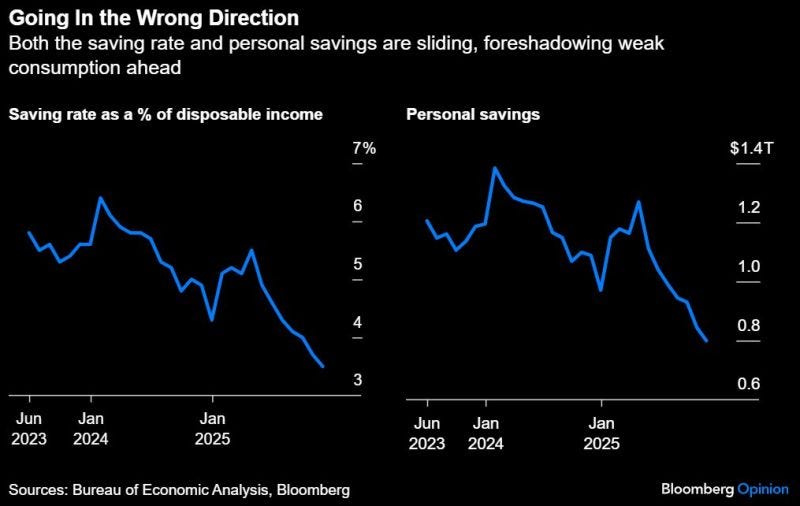
The personal saving rate has tumbled from 5.5% in April to 3.5% in November, the lowest since 2008 if we exclude the unusual COVID distortions of 2020.
At the same time, delinquency rates across loans - mortgages to credit cards - have risen to 4.8% in Q4, the highest since 2017.
When I read those numbers, I don’t immediately shout “recession.”
I read them as a narrative shift: the economy can still look fine in aggregates while the margin of safety disappears for millions of households.
This is the K-shaped economy in real time - where resilience is not evenly distributed, and where a soft landing in inflation can coexist with rising stress in cash flows.
And that’s where markets become tricky. In soft-landing phases, equities can keep going, but leadership usually becomes more selective.
Balance sheets matter more. Pricing power matters more. The rally becomes less about “everything up” and more about “the right things up.”
The historical anchor here is not meant to be dramatic - it’s meant to be honest about correlations.
When household stress becomes systemic, markets stop forgiving it.
In 2008, the S&P 500 returned -37.00%. I’m not calling 2008. I’m reminding you that the correlation between household fragility and market vulnerability is one of the few that remains brutally consistent across eras.
While savings are falling and delinquencies are rising, the commodities complex is not rolling over. That combination can sound contradictory until you see it for what it is.
The consumer is straining, but the global cycle is still pushing on real assets, and the dollar is losing some of its grip.
🧱 Commodities, EM Flows, the Yuan, and Capital Leaving the US
The commodities complex got caught in the crossfire of positioning last week - margin calls do what they always do - but structurally the chart still looks solid.
This matters more than people admit because commodities are the bridge between inflation, FX, and global liquidity.
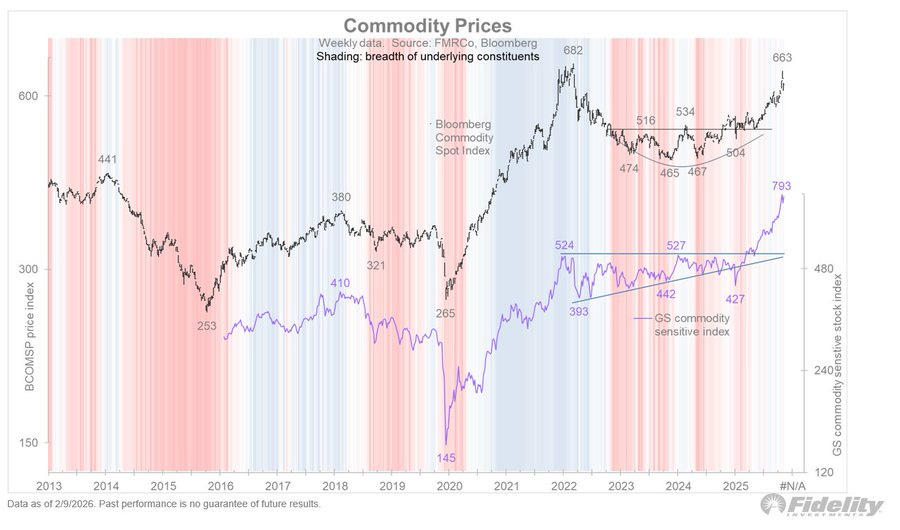
When commodities refuse to soften while CPI cools, I interpret it as a signal that the inflation impulse isn’t simply collapsing - it’s shifting.
It can mean global demand is firmer than investors assume, or that a softer dollar is feeding into broad price dynamics.
And it can mean that the path from 2.4% toward 2.0% is not linear, especially with Core Services still doing most of the work.
Market memory makes this correlation easy to visualize.
In periods when inflation sensitivity and real-asset demand dominate, broad commodity exposure tends to perform meaningfully.
As a proxy, GSG returned +15.57% in 2021 and +22.06% in 2022. Those weren’t calm years. They were years when markets relearned that real assets can become leadership, not just hedges.
Then the next chart adds the flow dimension.
Global Emerging Markets (GEM) equity funds are seeing record inflows since the start of the year, with early-year dynamics that resemble the strongest historical seasons in the post-2004 era.
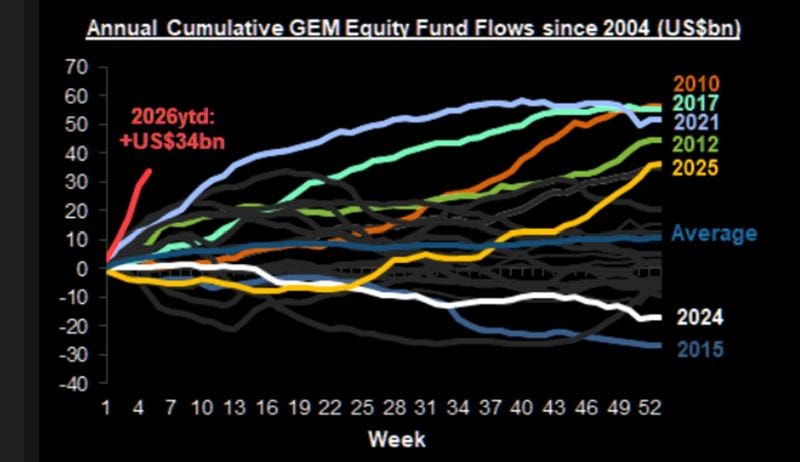
I treat this as slow capital changing its mind. EM isn’t just a geography; it’s a macro expression of a weaker USD, firmer commodities, and better global liquidity.
If you want a clean historical template for the correlation between EM flows and performance, 2017 is instructive.
In that year, EEM returned +37.28%, while the S&P 500 returned +21.83%. The mechanism is familiar: the dollar weakens, global risk appetite broadens, and under-owned markets re-rate faster than investors expect.
And then comes the FX confirmation.
The Chinese Yuan has strengthened to 6.91 per USD, the strongest since May 2023.
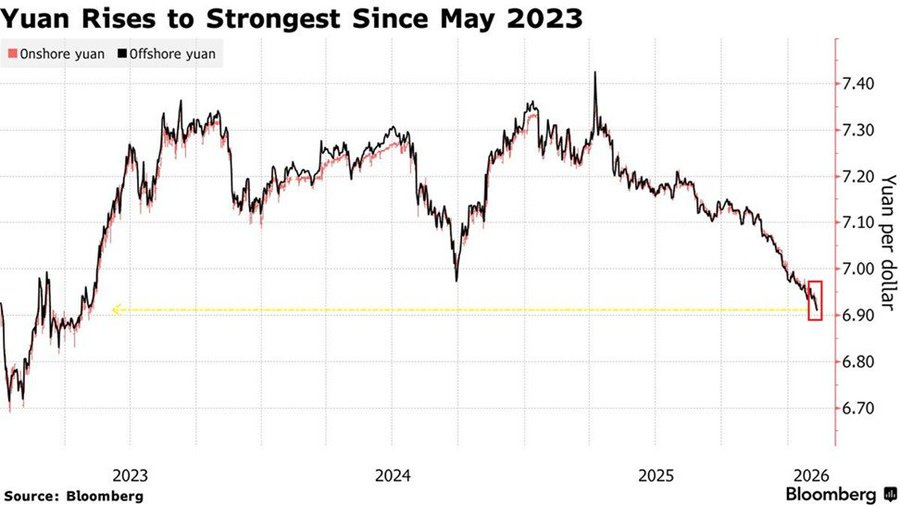
It’s on track for its 7th consecutive monthly gain, the longest streak since 2020 - 2021, and it’s up roughly ~5% since 2025. It has also been one of the strongest performers in Asia since September.
A strengthening yuan is not just a currency story - it’s a macro message. It tends to ease financial conditions across parts of Asia, reduce the “China stress premium,” and support broader EM risk appetite.
It also aligns with the narrative that Chinese regulators have advised banks to limit purchases of US Treasuries and encouraged institutions with high exposure to pare positions down.
If that is even partially true, it fits the broader theme: a weaker USD, improving non-US risk appetite, and gradual diversification away from US duration.
Then the flow chart on global equities makes the regime shift explicit.
Investors are rotating out of US stocks at a historic pace. International equity funds have attracted +$104bn in net inflows YTD, which is four times the +$25bn that flowed into US funds. Developed markets have seen nearly $140bn of inflows.
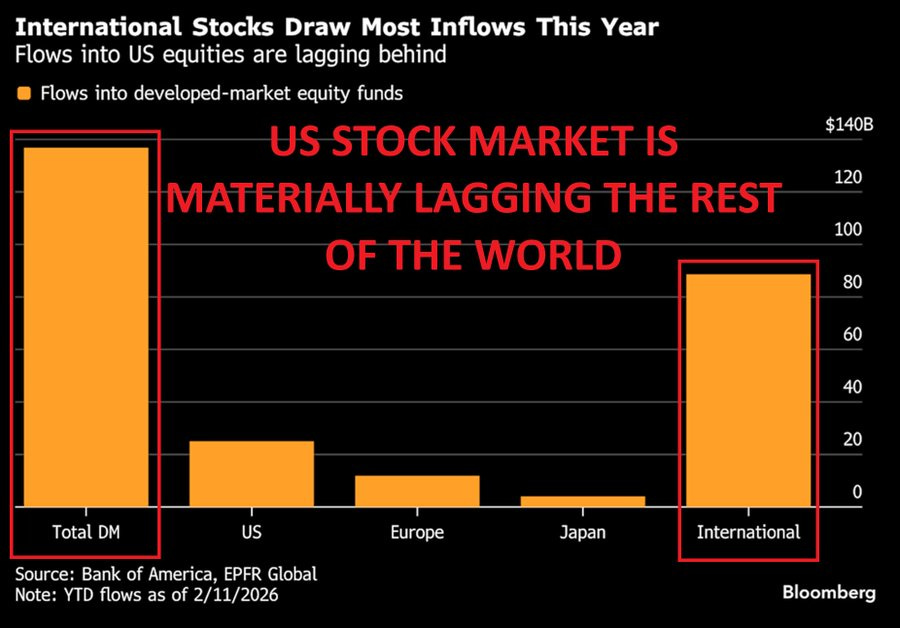
This isn’t a polite rebalance. It’s a statement.
And performance already echoes it. The S&P 500 is up +16% since the start of 2025, but MSCI ACWI ex-US is up +45%.
I know the line “the era of US dominance has finished” sounds like a headline.
But what matters to me isn’t the slogan - it’s the mechanism. Flows follow incentives. Incentives are changing.
When the world starts believing in broader leadership, it usually doesn’t happen in a straight line.
It happens through volatility, skepticism, and uncomfortable transitions. Which is exactly why it creates opportunity.
But to understand how this rotation can coexist with Fed easing, we have to look at the curve.
⭐️ This is a paid content, so scroll to read it…[🎁 #7 BONUS if you become a PRO today]
If you’re a PRO subscriber, make sure you’re logged in to access the full piece.
If you’re still a FREE reader, you have exclusive options to unlock this special edition and all past PRO content.
🗣️ Read what others say about us. TrustPilot - Don’t take my word for it.
🎁 Special Today - 7 bonuses if you become a PRO (FREE)👇
(These bonuses alone are worth more than the subscription.)
🎁 BONUS #1 - Price Locked Forever (you’ll never pay more)
🎁 BONUS #2 - Monthly Live Mastermind (value: $1,197/year)
🎁 BONUS #3 - Full App Access: all exclusive content, anytime, anywhere
🎁 BONUS #4 - Private Community Access: the Macro Mornings Family
🎁 BONUS #5 - Premium charts + Macro Asset Dashboard (FREE version)
🎁 BONUS #6 - Full access to 650+ advanced research analysis
🎁 BONUS #7 - Free copy of my book “51 macro strategies”
🚨 February 2026 Flash Sale
✅ Macro Mornings PRO (Save 40% forever)
Only 6 spots left → FROM $570/year TO $342/yr (or $29/month)
✅👑 Lifetime (Best value)
Only 6 spots left → FROM $1,140 TO $798 one-time (or $13/month)
👉 After payment, you’ll receive a Welcome Kit by email with all the material and instructions to join.
2. 👉 Or start your 7-day FREE Trial - exploring only the PRO analyses without any risk. [Click here]
Keep reading with a 7-day free trial
Subscribe to Macro Mornings 💡 to keep reading this post and get 7 days of free access to the full post archives.