
🤯 The Asset Everyone Ignored… Until Now
September 11, 2025 >> Something Big Is Happening in the Metals Market

💡 New on Macro Mornings? Start here
🎯 This is part of a series designed for PRO investors who want real-time updates on macroeconomic news through my advanced insights. Feel free to catch up on previous emails here if you'd like to start from the beginning!

Dear all,
Every so often, I find myself staring at the numbers, the charts, and the revisions, and I get the sense that history is not just rhyming - it’s practically shouting at us.
The data pouring in from different corners of the market tells a story that feels like a blend of different eras I’ve studied over the years: the stagflationary shocks of the late 1970s, the mania of the late 1990s, and the liquidity floods of the post-2008 and post-2020 worlds.
As I piece this together, I want to take you with me on this journey through the numbers and through history, because what we are witnessing today is not ordinary - it’s transitional.
And transitions always demand perspective, patience, and preparation.
✨ The Return of the Metals
Gold miners have been nothing short of spectacular this year, rising nearly +90% YTD, while the rest of the S&P 500 sectors have struggled to keep pace with gains between +5% and +15%.
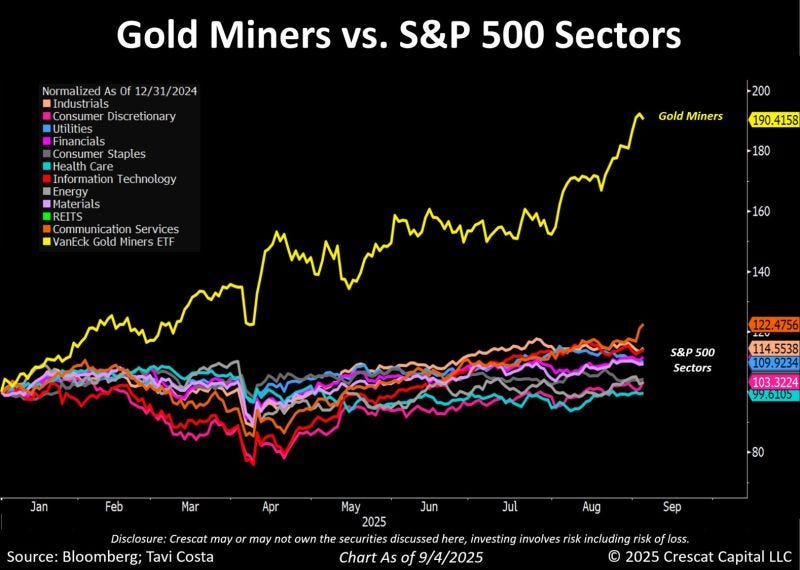
This divergence instantly brings me back to 1979 - 1980, when the Philadelphia Gold and Silver Index skyrocketed +120% in just 18 months, while the S&P 500 actually fell -8%.
Those who lived through that time remember what it felt like: inflation out of control, growth sputtering, and investors desperately seeking refuge in the only asset that seemed untouchable.
The same echoes are alive today.
Gold itself has crossed $2,500/oz, defying one of its oldest enemies: rising real yields.
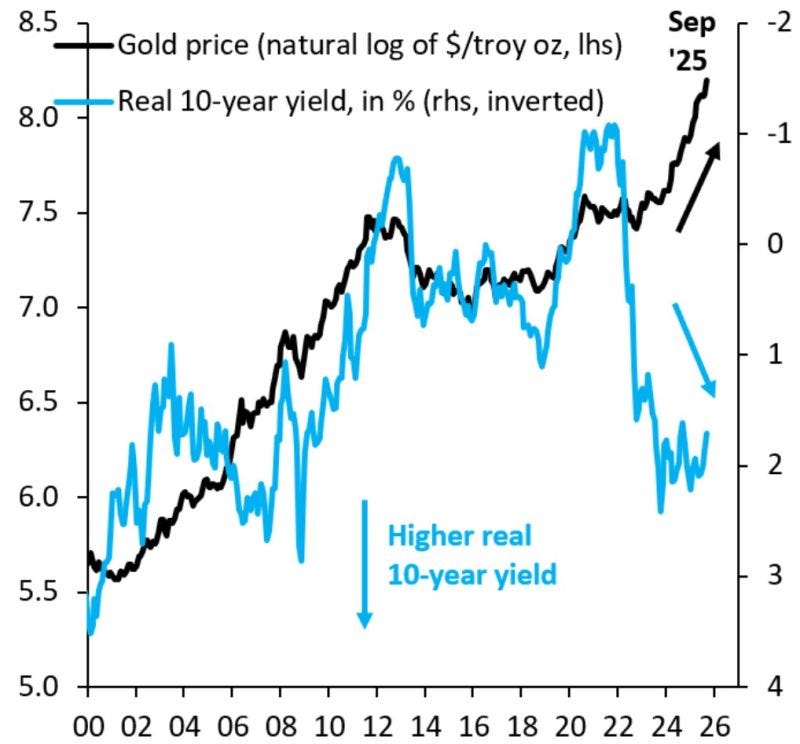
After 2008, a similar rise in real yields knocked gold down by -35%, but this time the relationship is broken.
Typically, every 1% increase in real yields drags gold lower by 8 - 10%, but in 2025 we are watching the opposite unfold.
It reminds me of the 2010 - 2011 surge, when gold shrugged off tightening conditions and the USD index dropped -14% while commodity currencies like the Aussie and Canadian dollars gained more than +20%.
When I look at silver, the message becomes even louder.
Silver is already up +42% this year, and lease rates have spiked above 5% - a signal of tightening supply and physical scarcity.
The last time silver moved like this was in 2010 - 2011, when it climbed +150% in just 18 months, nearly touching $50/oz.
Gold followed with an +80% gain, while equities barely scraped together +11%.
Whenever precious metals shout this loudly, it is rarely without consequence.
They are often the canaries in the coal mine of the global financial system.
🏦 Central Banks and the Illusion of Stability
The Fed’s recent 50 bps cut while the S&P 500 sat less than 1% from its all-time highs is a moment I cannot ignore.
It feels counterintuitive, yet history shows us a fascinating pattern.
Since 1980, Fed cuts near highs have almost always propelled equities higher: on average, +3.3% in 3 months, +5.5% in 6 months, and +9.8% in the following year, with markets finishing higher 100% of the time after one year.
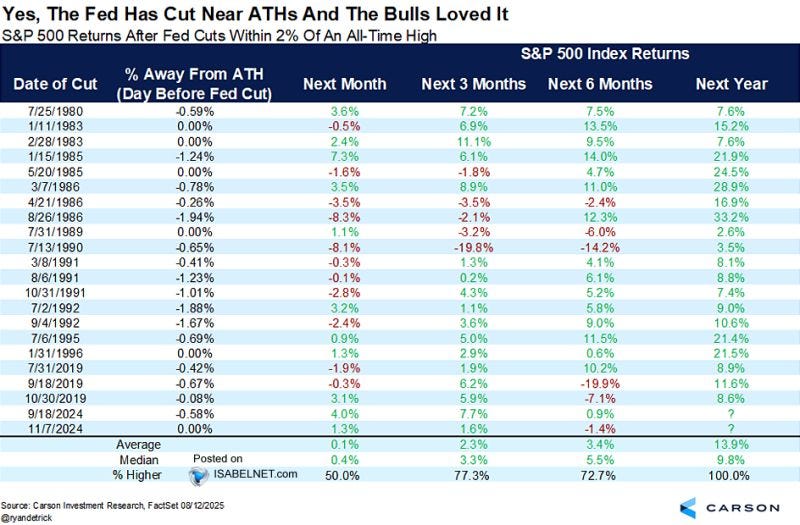
The 1995 cut comes to mind, sparking a +36% rally in 18 months and reinforcing investor confidence.
But the shadow of 2001 also looms large.
Then, the Nasdaq collapsed -49% despite the rate cuts, as earnings collapsed and valuations proved unsustainable.
Bonds tell their own story during such cycles.
In periods of mid-expansion cuts, the 10-year Treasury yield often falls 70 - 100 bps within a year.
That drop feeds into credit markets, mortgage rates, and global capital flows.
It creates fuel for risk assets - but it also exposes fragilities that can no longer hide.
Liquidity has a way of carrying markets higher, sometimes to dizzying heights, but it also masks weaknesses until they can no longer be ignored.
I find myself wondering: is this another 1995, when the cut extended the cycle, or another 2001, when it marked the beginning of the end?
💻 The Fragility of Concentration
It is impossible for me to overlook the dominance of technology in today’s market.
The ratio of tech to the S&P 500 has surged to 0.82x, even higher than the 0.67x peak of the Dot-Com Bubble.
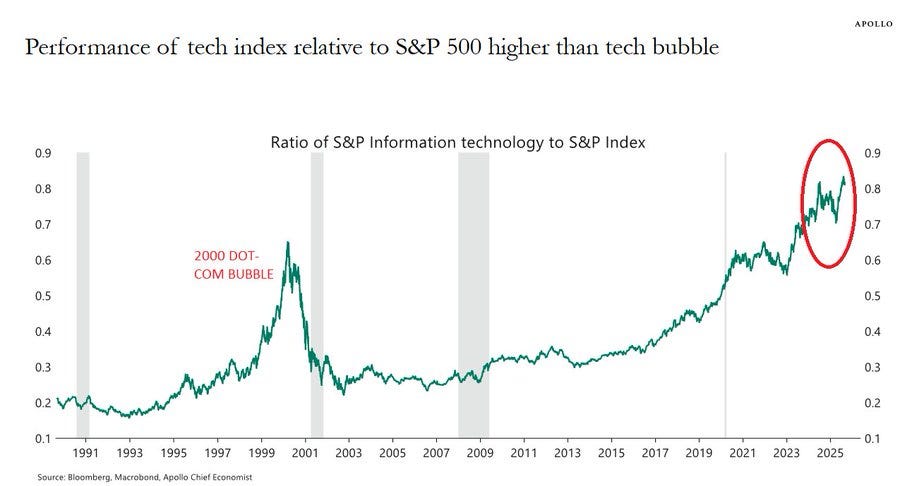
The five titans - Nvidia, Microsoft, Apple, Alphabet, and Amazon - now represent ~28% of the index.
At the peak of the bubble in 2000, the top five were just 17%.
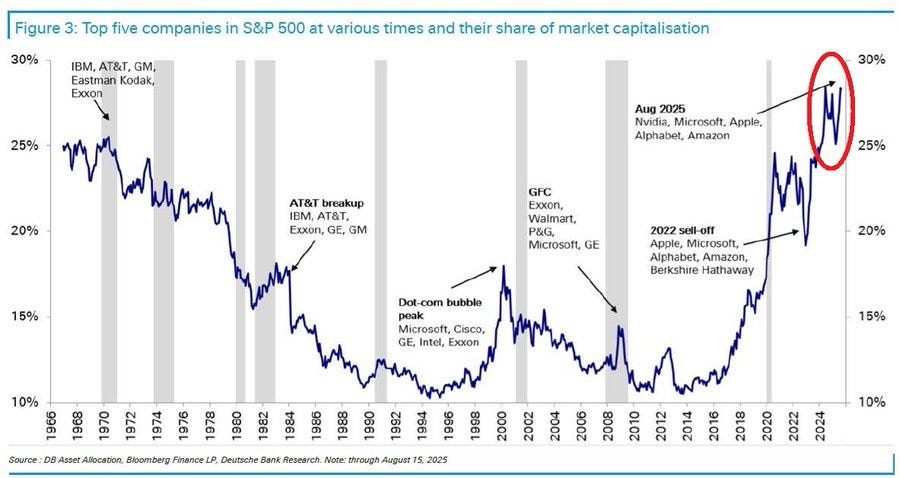
We know what followed: the Nasdaq collapsed -78%, and currencies like USD/JPY rallied +20% as capital fled into safety.
Concentration at this level makes markets fragile.
It creates an illusion of unstoppable momentum, but history tells me that when leadership narrows to this degree, the structure becomes brittle.
It can break suddenly and violently, as it did in 2000.
I think often about what this means for today’s investor.
On the one hand, these giants have balance sheets, cash flows, and global dominance that their predecessors in 2000 could only dream of.
The math of concentration doesn’t change: when nearly a third of an index depends on five companies, diversification disappears, and volatility risk explodes.
The parallels to 1999 are too strong to dismiss.
📉 Signals Beneath the Surface
And then there is the labor market, the quiet but crucial foundation of the economy.
The BLS recently revised job numbers down by -911,000, the largest revision in U.S. history, even larger than the -902,000 in 2009 during the depths of the financial crisis.
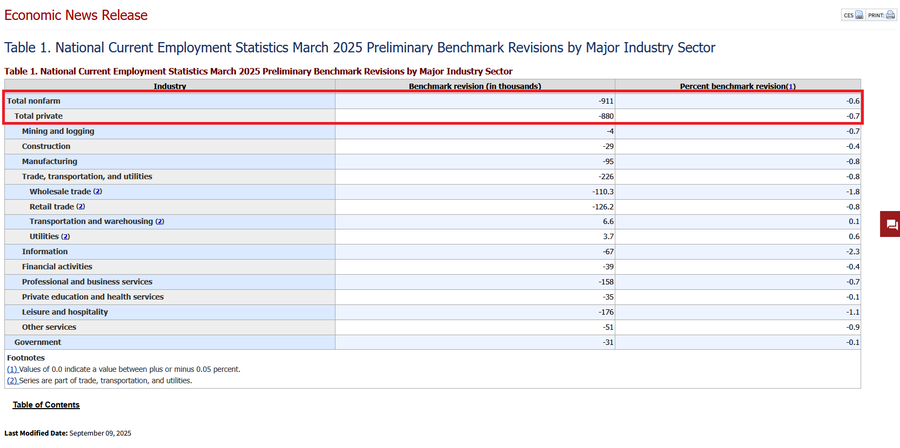
I remember how markets reacted then: the S&P 500 sank another -27%, Treasury yields collapsed from 3.9% to 2.1%, and the euro surged +17% against the dollar.
These revisions are not trivial; they are often harbingers of trouble ahead.
They whisper that the economy is not as strong as it seems, that cracks are forming in earnings and credit markets, and that the resilience we thought we had may be overstated.
Layer on top of this the global liquidity surge.
Broad money supply has reached $140 trillion, a record, and it has risen $20 trillion in just three years.
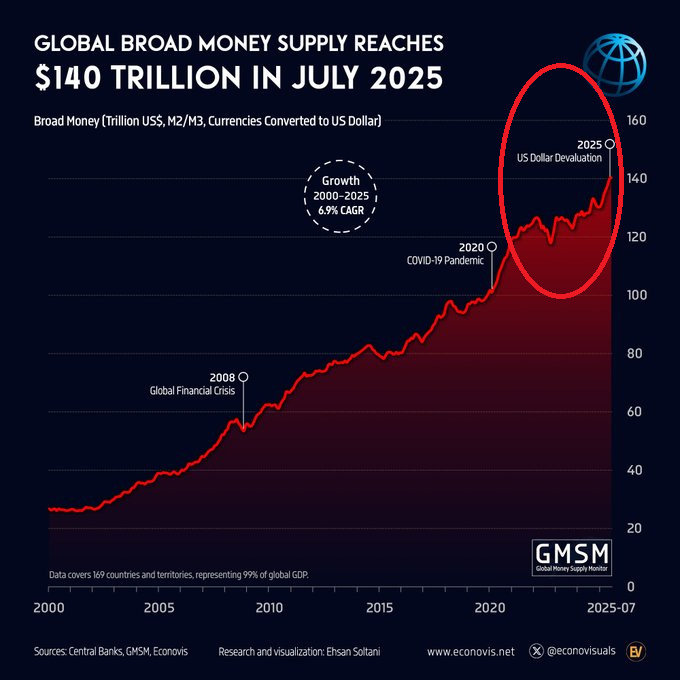
That’s a staggering pace, nearly 7% annual growth since 2000.
I’ve watched what liquidity waves can do.
After 2008, the MSCI World Index surged +78% in just three years.
After the 2020 pandemic, the S&P 500 doubled, gaining +114% from trough to peak.
And yet, I’ve also seen how these floods distort markets.
During 2020 - 2021, the USD weakened -12%, and emerging market currencies rallied +18%.
Liquidity creates booms, but it also sows the seeds of excess.
And excess always finds a way of correcting itself.
⭐️ This is a paid content, so scroll to read it…
If you're a PRO subscriber, make sure you're logged in to access the full piece.
If you're still a FREE reader, you have two exclusive options to unlock this special edition and all past PRO content:
1. 👉 Pro Membership from 30% to 40% OFF - forever. Only while spots last:
🎁 PRO Member - $268/year or $22/month (Regularly $447) [Click here]
🎁 Lifetime - $621 one time only or $10/month (Regularly $887) [Click here]
These prices it’s locked forever.
2. 👉 Or start your 7-day FREE Trial - explore everything without any risk.
If you're serious about understanding what comes next - and acting before the crowd - this email is your edge.
Keep reading with a 7-day free trial
Subscribe to Macro Mornings 💡 to keep reading this post and get 7 days of free access to the full post archives.