
🤯 [PANIC] 2 Standard Deviations above the mean for the first time ever
March 27, 2026 >> What does it mean? The pattern is consistent

🔒 JOIN FREE THE MACRO MORNINGS FAMILY
👉 FREE - Start Here
45 minute mentorship with the Founder - [Schedule your call]
Global Macro Strategy Summit 2026 - [Get your ticket]
👉 PRO - Unlock More
👑 Macro Mornings PRO Lifetime (Best Value) - Only 6 spots left
Macro Mornings PRO Annual - Only 5 spots left
Macro Asset Dashboard + Model Portfolio Allocation [View the demo] - Only 5 spots left

Dear Investors,
There are moments when I don’t feel as if I’m simply reading markets.
I feel as if I’m reading the emotional condition of an era.
That is exactly how I felt while going through this sequence of charts.
At first, they seem to speak different languages. But the longer I sat with them, the less these charts felt like separate observations and the more they felt like a single narrative unfolding in chapters.
And the story they tell isn’t a small one.
To me, it is the story of a market that is being forced to rediscover something it had gradually forgotten during the long age of easy money and financial abundance: that macroeconomics still matters, that supply still matters, that social stability matters, that politics can move asset prices as powerfully as central banks, and that real assets don’t disappear just because financial assets spent years dominating the conversation.
For a long time, many investors were able to live inside a very comfortable mental model.
When growth slowed, rates would eventually come down. When volatility rose, liquidity would eventually return. When valuations stretched, the market would forgive them because the discount rate remained friendly. When politics became noisy, investors assumed institutions would ultimately absorb the shock.
That framework created a very particular habit of mind. It encouraged people to buy duration, to trust multiple expansion, to treat commodities as peripheral, and to assume that social stress would remain a background issue rather than a market driver.
I think these charts challenge that habit of mind.
🌍 The backdrop beneath the market is more fragile than it looks
If I had to begin this entire discussion from one place, I would begin with the chart showing that the top 1% now holds the largest share of wealth in nearly 90 years.
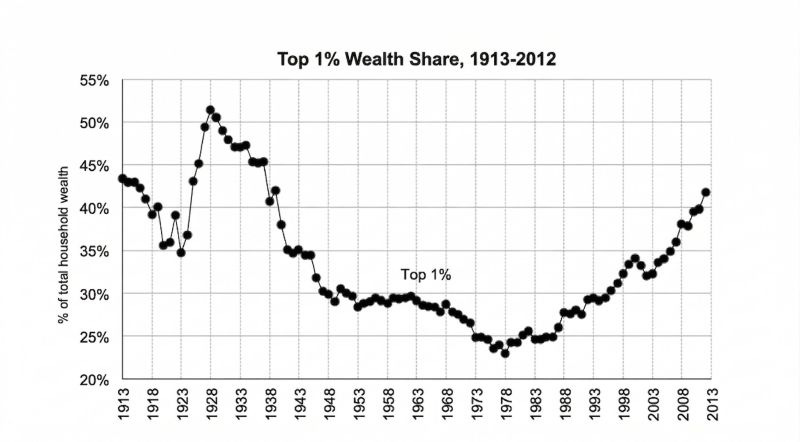
I don’t see that as a social side note. I see it as the foundation of the whole macro setup.
Because when wealth becomes this concentrated, the economy can continue looking functional on the surface while becoming much more fragile underneath.
Aggregate spending can still look decent. Asset prices can still signal confidence. Employment can still appear resilient. Yet the median household becomes progressively less insulated from the cost of essentials.
And once that happens, any rise in food prices, gasoline prices, rent, or utilities begins to hit a system that has far less capacity to absorb it than headline averages imply.
That is why I think rising food and energy prices are so dangerous in the current environment.
A 10% move higher in oil does not arrive evenly.
A rise in gasoline from $3.50 to $4.25 is not experienced as a clean number across the population. For some households, it is irritating. For others, it is the difference between flexibility and stress.
And when that stress reaches enough people at the same time, it doesn’t remain confined to the household budget. It leaks into political sentiment, social frustration, consumer behavior, and eventually into the pricing of financial assets.
This is one of the reasons I find the current moment so important. When inequality is already deeply embedded, inflation stops being just a macro statistic. It becomes a destabilizing force.
History was brutally clear about this in the 1973-1974 oil shock.
WTI rose from roughly $3.56 in early 1973 to $10.11 by January 1974, a jump of about 184%.
Over the same stretch, the S&P 500 fell 14.3% in 1973 and another 25.9% in 1974.
Gold rose 73.0% and then 66.2%, while the 10-year Treasury yield climbed from 6.40% at the end of 1972 to 7.40% by the end of 1974.
Whenever I place those numbers next to one another, I see a classic stress correlation. Equities lose altitude because growth confidence erodes. Gold strengthens because capital begins searching for shelter outside the financial system. Bond yields rise rather than cushion the shock, because inflation contaminates what investors expected to be safe. The hierarchy of safety starts to blur.
That is the first major lesson I take from this entire sequence of charts. When inequality is extreme and essentials become more expensive, the market doesn’t merely price inflation. It starts pricing the political and social consequences of inflation.
And that leads naturally to the next part of the story, because once the social backdrop is fragile, oil becomes much more than just another commodity.
Oil becomes the purest macro transmitter in the system.
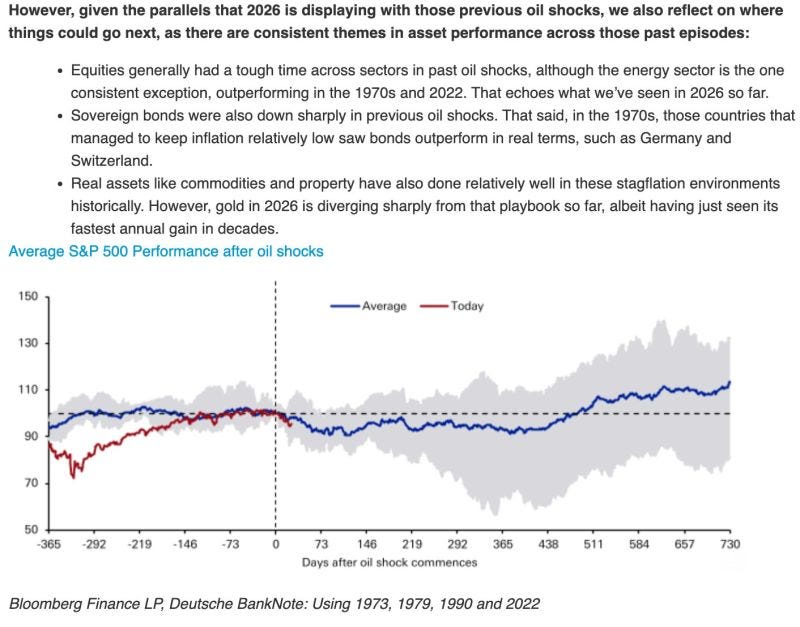
This is why the Deutsche Bank framing matters so much to me. When I look back at 1973, 1979, 1990, and 2022, I don’t see identical episodes, but I do see recurring patterns that are too consistent to ignore.
Equities usually struggle in some form, even when the full damage is not immediate. Energy tends to be the most reliable exception. Sovereign bonds don’t always provide the protection investors expect, especially when inflation credibility is part of the problem. And real assets tend to recover importance precisely when paper assets become harder to justify.
The 1979-1980 oil shock captures this beautifully. WTI rose from around $14.85 in January 1979 to $39.50 by April 1980, which amounts to roughly 166%. On the surface, someone could argue that equities coped just fine because the S&P 500 returned +18.5% in 1979 and +31.7% in 1980.
But that superficial reading misses what really happened beneath the surface.
10-year Treasury bond total returns were only +0.7% in 1979 and -3.0% in 1980, while the 10-year Treasury yield rose from 10.45% at the end of 1979 to 12.29% by the end of 1980. At the same time, gold surged +126.6% in 1979.
That is why I keep saying the real correlation is not always as simple as “oil up, stocks down.” Sometimes the more important pattern is subtler and more revealing: oil rises, inflation becomes more persistent, yields rise, the quality of financial returns deteriorates, and hard assets begin to lead.
To me, that is exactly the kind of environment the market may be drifting toward again.
If oil remains elevated for the next 3 to 6 months rather than the next 3 to 6 weeks, I would expect pressure to broaden. Transportation margins would feel it. Consumer discretionary would feel it. Industrials would begin to feel it.
And if crude remains structurally 15% to 20% above pre-shock levels, then I think the market will have a much harder time calling this a temporary disruption. It’ll begin to speak of sticky inflation pressure, and once that happens the repricing of multiples can accelerate quickly.
That is why I don’t look at oil here as a side variable.
I look at it as the heartbeat of the entire regime discussion.
🛢️ The shock is real, the buffer is real, and the rotation may still be early
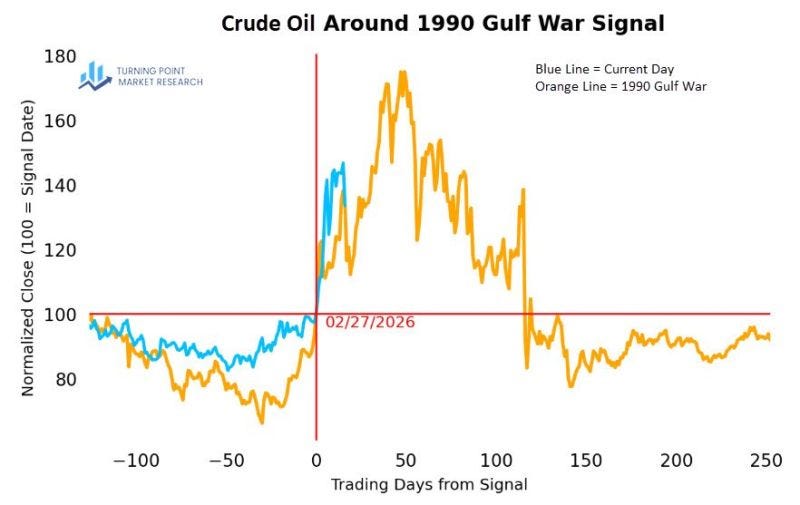
The chart comparing today’s oil move with the 1990 Gulf War analog is one of the most visually compelling in the entire set, and I think it gives us a very useful map.
I always try to be careful with analogs.
I don’t believe that history repeats cleanly enough for analogs to become predictions. But I absolutely believe that analogs can teach us about sequence, and sequence matters enormously in markets.
In 1990, WTI fell to around $16.87 in June, then surged to $35.92 by October, a move of roughly 113% in only a few months.
What fascinates me about that episode is not just the speed of the oil move, but the behavior of the other major assets around it.
The S&P 500 finished 1990 down only 3.1%, 10-year Treasury bond total returns were +6.2%, and the 10-year Treasury yield rose only modestly, from 7.93% at the end of 1989 to 8.15% by the end of 1990.
Then the emotional tide turned. In 1991 the S&P 500 gained +30.2% and 10-year Treasury bonds returned +15.0%.
That is a sequence I take very seriously.
It tells me that when the oil shock is geopolitical and acute, markets often move through distinct phases. First, energy reacts violently because the fear is immediate. Then broader risk assets wobble because inflation, margins, and growth need to be repriced. But if the event starts to look containable rather than permanent, relief can arrive with surprising force.
This is why I find the analog so helpful today. If crude continues to track that 1990 path for another 20 to 40 trading days, markets may still have to price a longer inflation impulse than consensus expects. But if the analog begins to break lower, risk assets could enjoy a tactical relief rally even if the bigger regime shift remains intact.
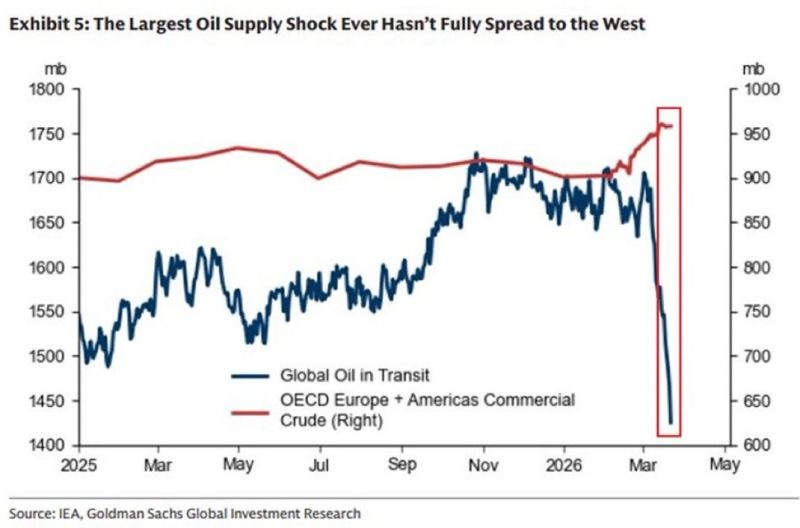
And this is where the Goldman Sachs chart adds a crucial layer of nuance.
Global oil shipments have dropped by roughly 270 million barrels in just three weeks, which is an extraordinary figure.
Yet OECD Europe and the Americas entered this phase with unusually high commercial crude inventories. That means the West is insulated, at least for now, by buffers that delay the full transmission of the shock.
I think that delay is one of the most misunderstood parts of the current market.
Investors are often tempted to interpret delayed pain as absent pain. But those are not the same thing. Inventories don’t abolish a shock. They stretch it across time.
And when a shock is stretched across time, the market often behaves in stages. Commodities lead first. Broader risk assets begin to weaken with a lag. Political sensitivity rises as households start to feel the knock-on effects. Then, if the shortage proves temporary, a sharp relief rally can follow.
That is why I find the current Western calm somewhat deceptive. I don’t read it as evidence that the shock doesn’t matter.
I read it as evidence that the transmission mechanism has not fully completed its journey yet.
This is also the point in the narrative where the chart on the commodities-to-equities ratio becomes so important to me.
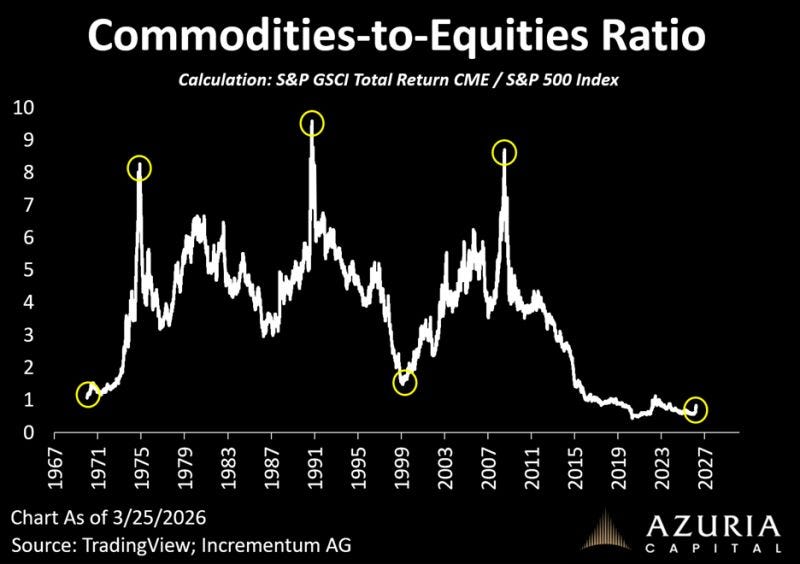
Even after the recent move, that ratio remains historically depressed.
And when I look at it, I don’t see a tactical bounce that has already run too far. I see the possibility that hard assets are still under-owned relative to the world that may be emerging.
This matters because investors spent so many years in an environment where commodities felt peripheral. In a world of falling yields, asset-light growth models, low inflation, and generous multiple expansion, real assets were often treated as an outdated sideshow. But that mentality can become dangerous when the macro regime begins to change.
A world of tighter supply chains, energy insecurity, reindustrialization, geopolitical fragmentation, and recurring inflation volatility is not a world in which hard assets should be dismissed as temporary trades. It is a world in which they may need to be treated once again as strategic exposures.
We already had a taste of this correlation shift in 2022.
The S&P 500 fell 18.0%, while 10-year Treasury bonds fell 17.8%. That was one of the clearest reminders in decades that the traditional 60/40 framework can fail when inflation is the dominant force.
Meanwhile, gold was roughly flat at +0.6%. That may not sound thrilling in isolation, but in relative terms it mattered. It preserved value far better than long-duration financial assets whose pricing depended on lower yields and softer policy.
This is the core correlation I keep coming back to. When inflation becomes the main macro driver, stocks and bonds can fall together, and investors begin to remember why hard assets exist in portfolios at all.
So when I look at the commodities to equities ratio now, I don’t just see a chart at depressed levels. I see a possible structural repricing that may still be in the early innings. If that ratio even partially mean-reverts toward prior cycle norms over the next 2 to 4 years, I think there is still substantial room for commodity-linked assets to outperform broad equities.
That is why I continue to view the move from financial assets toward hard assets as something larger than a short-term trade.
To me, it increasingly looks like a long story just beginning to be priced.
⭐️ This is a paid content, so scroll to read it…[🎁 #7 BONUS if you become a PRO today]
If you’re a PRO subscriber, make sure you’re logged in to access the full piece.
If you’re still a FREE reader, you have exclusive options to unlock this special edition and all past PRO content.
🗣️ Read what others say about us. TrustPilot - Don’t take my word for it.
🎁 Special Today - 7 bonuses if you become a PRO (FREE)👇
(These bonuses alone are worth more than the subscription.)
🎁 BONUS #1 - Price Locked Forever (you’ll never pay more)
🎁 BONUS #2 - Monthly Live Mastermind (value: $1,197/year)
🎁 BONUS #3 - Full App Access: all exclusive content, anytime, anywhere
🎁 BONUS #4 - Private Community Access: the Macro Mornings Family
🎁 BONUS #5 - Premium charts + Macro Asset Dashboard (FREE version)
🎁 BONUS #6 - Full access to 650+ advanced research analysis
🎁 BONUS #7 - Free copy of my book “51 macro strategies”
🚨 March 2026 Flash Sale
✅ Macro Mornings PRO (Save 30% forever)
Only 4 spots left → FROM $570/year TO $399/yr (or $33/month)
✅👑 Lifetime (Best value)
Only 5 spots left → FROM $1,140 TO $798 one-time (or $13/month)
👉 After payment, you’ll receive a Welcome Kit by email with all the material and instructions to join.
2. 👉 Or start your 7-day FREE Trial - exploring only the PRO analyses without any risk. [Click here]
Keep reading with a 7-day free trial
Subscribe to Macro Mornings 💡 to keep reading this post and get 7 days of free access to the full post archives.