
🪙 [ARRIVED] Another super cycle against equities
December 28, 2025 >> What you shoud now...

[🎟️ COMMUNITY RESERVED] Early Bird Access is live
🎥 Global Macro Strategy Summit (LIVE Online) December 12-13th, 2026
Markets shift fast. This is where you stop reacting-and start positioning with a framework.
Claim Day 1 for free, or secure PRO/VIP Early Bird before prices move.
NEXT EVENTS
👉 LIVE Mastermind Session - January 17th, 2026 - [Get Your Free Access]

Dear Investor,
I want to tell you a story today - not a motivational story, not a “market is up so everything is fine” story - but the kind of story that only becomes visible when you line the charts up in the right order and let them speak to each other.
Because when I place them exactly as you shared them, I don’t see eight separate ideas.
I see one narrative unfolding in real time: liquidity is surging, the consumer is quietly bracing for weaker labor conditions, inflation data is becoming harder to trust, and policy is searching for a way to keep the long end of the curve from becoming the system’s weak spot.
From there, the plot naturally shifts to the dollar, then to gold, and finally to the commodity complex - exactly the chain you’d expect in a world moving from “growth certainty” to “regime management.”
Let me walk you through it in the same sequence, without changing a single number, but with the context that makes the numbers feel alive.
🚨 The fuel is back, and I can feel the market breathing again
The first chart does something to my mindset immediately: it forces me to respect the backdrop.
Global liquidity is at a fresh all-time high, hovering around $150T on the aggregate measure.
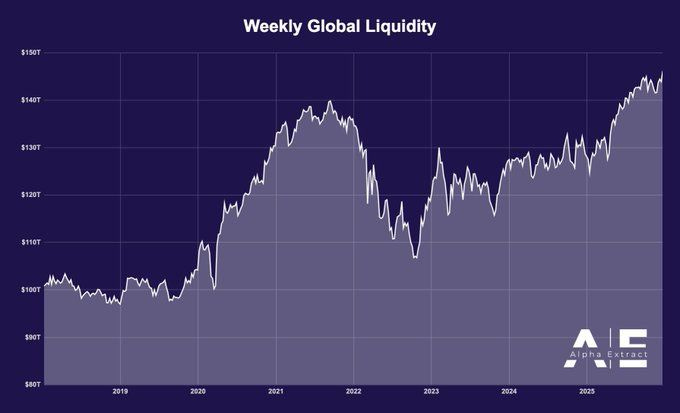
That is not a minor detail. It is the kind of condition that tends to keep risk assets from suffocating, even when the newsflow tries to scare everyone into defensive postures.
And the way we got here matters.
China is adding roughly ¥1T per week. The Fed is effectively expanding around $30B. Japan approved a $114B package. India announced $32B of stimulus.
Different economies, different motivations, but the same direction: support is creeping back into the system.
When liquidity rises, markets tend to regain oxygen.
I don’t say that as a slogan - I say it because the tape is there.
In the most obvious modern liquidity impulse, the S&P 500 Total Return delivered +18.40% in 2020 and +28.71% in 2021.
You could argue about narratives, but you can’t argue with the mechanics: easier financial conditions tend to lift the surface of risk.
The caution is that liquidity can support prices while simultaneously planting the seeds for instability in correlations if inflation and term premium become the price of that support.
We saw that too. When the impulse flipped and the market had to reprice the cost of money, the S&P 500 Total Return was -18.11% in 2022 - and what made that year unforgettable for professionals was not the equity drawdown alone.
It was the betrayal of the classic hedge.
Bonds didn’t protect you. The U.S. aggregate bond benchmark fell about -13.02%.
So the correlation lens I carry into the rest of this email is simple: when liquidity expands, equities and credit tend to respond first, but if inflation uncertainty rises, duration can stop acting like insurance.
That distinction is everything, because it changes what kind of “risk-on” you’re living through. Sometimes liquidity gives you a clean bull.
Other times it gives you a market that rises while rotating violently underneath.
And that brings me to the second chart - because it’s the one that tells me where the hidden fragility may be forming.
🟠 The consumer is whispering what the hard data hasn’t shouted yet
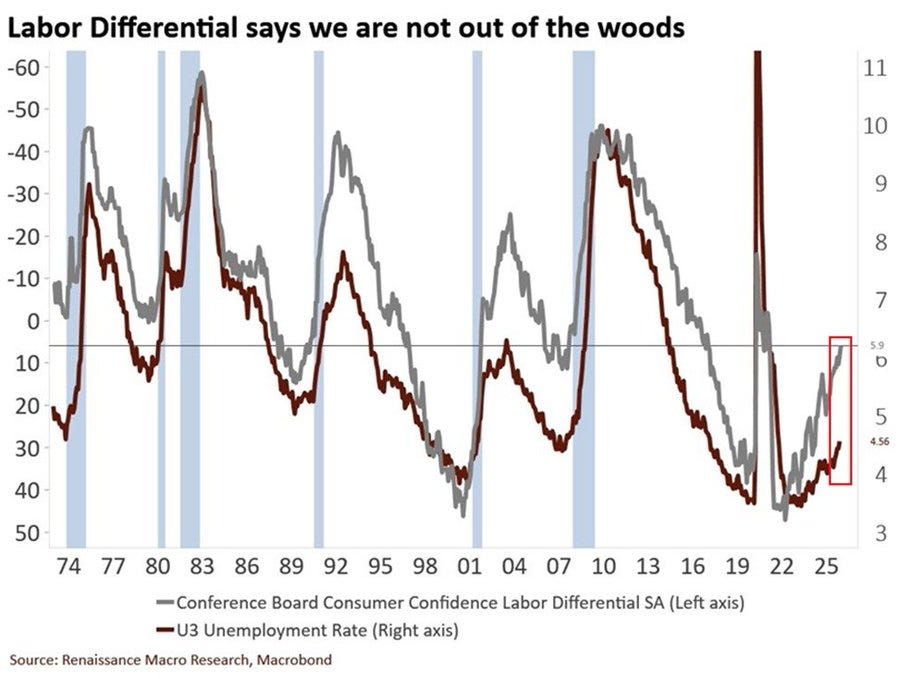
The labor differential chart always feels personal to me, because it’s one of the rare indicators that comes straight from human experience.
People don’t need a model to sense when the job market is changing. They feel it before economists confirm it.
The numbers this week are not subtle. The share of Americans saying jobs are “hard to get” is up to 20.8%, the highest in four years.
Those saying jobs are “plentiful” is down to 26.7%, the lowest in four years. The labor differential falls to 5.9, the lowest since 2021.
When I see that, I don’t treat it like a footnote.
In prior business cycles, this measure has been a leading indicator of rising unemployment.
That’s why your interpretation lands: if the relationship holds, the unemployment rate could rise toward ~6% from the current ~4.6%.
I’ve learned to think of this as the “emotional front-runner” of the labor market.
First, confidence breaks. Then consumption becomes cautious. Then earnings guidance gets careful. Then credit spreads start whispering.
And finally, the headline unemployment rate catches up - usually at the moment when the public is already convinced the downturn is obvious.
If you want the historical tape that keeps me disciplined, I go back to the last time the labor market truly cracked under pressure.
In the 2007 - 2009 crisis, unemployment reached 10.2% at the peak, and the S&P 500 experienced a -56.8% peak to trough drawdown.
That’s the harsh truth about labor deterioration: it doesn’t just affect “sentiment,” it changes the pricing of risk itself.
Labor weakness doesn’t automatically mean a straight-line bear market, especially if liquidity is expanding.
What it often creates is a two-speed market. The first speed is fear - risk sells off because growth is wobbling.
The second speed is relief - risk stabilizes because policy turns more supportive.
That transition can be violent, and it’s one reason why this year feels like it could be defined by whiplash rather than clarity.
And then we reach the third chart, which explains why the whiplash risk is higher than usual.
🧊 When the data becomes less trustworthy, the distribution of outcomes gets wider - and markets price that
The CPI chart is not just technical; it’s philosophical. It asks: how confident are we in the numbers that drive the most powerful institution in markets - central banks?
In October, a record 40% of core CPI items were estimated, with 22 percentage points coming from rents and 18 points from other commodities and services.
Overall, about 34% of all inflation components were estimated using other items or geographies.
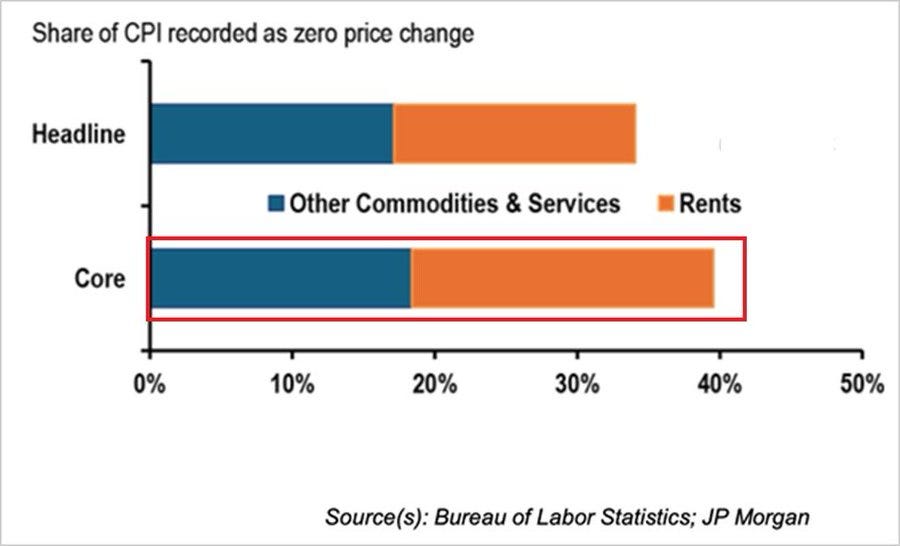
This is the fifth consecutive reading above 30%, more than triple what was typical in the 2022 - 2024 period.
Under normal conditions, the BLS measures inflation using about 90,000 monthly price observations across around 200 categories, and estimates tend to be roughly ~10% of entries.
We are far from normal conditions.
I interpret that in one sentence: when the inflation tape gets noisy, the risk of policy error rises.
And when policy error risk rises, markets stop trading the “point forecast” and start trading the “probability distribution.”
That’s when volatility becomes structural, not accidental. That’s when small surprises create big moves, because conviction is lower and hedging demand is higher.
Again, the tape is there. 2022 was the living case study. Equities were down -18.11%, bonds were down -13.02%, and the core diversification framework failed exactly when people needed it most.
That is what happens when inflation uncertainty dominates: correlations become less friendly, and rates volatility becomes the heartbeat of the entire system.
Now, it would already be enough to stop here and say, “Okay, liquidity is high, labor is wobbling, inflation data is noisy - prepare for volatility.”
But the next chart takes the story deeper, because it introduces something markets love: asymmetry.
You talked about the Treasury’s problem, and you framed the “gold certificate” concept.
I want to keep your numbers exactly as they are, and tell you why I think this matters - not as a trade, but as a regime thought experiment.

The U.S. has about $38T in debt, but the pressure point isn’t the whole stock.
The stress point is the part where demand is most fragile: roughly $5T of ultra-long maturity bonds in the 20 - 30 year space, where duration, liquidity, and uncertainty make appetite thinner.
The Fed holds gold as gold certificates recorded at $42/oz, worth roughly $11B on the balance sheet.
⭐️ This is a paid content, so scroll to read it…[🎁 #7 BONUS if you become a PRO today]
If you’re a PRO subscriber, make sure you’re logged in to access the full piece. And if you’re already Annual/Lifetime member 👉 Access to 🧠 Macro Mornings Family.
If you’re still a FREE reader, you have two exclusive options to unlock this special edition, all past PRO content and the App’s Special launch:
1. 👉 Pro Membership from 30% to 50% OFF - forever. Only 3 spots last:
⭐ PRO Membership - $399/year or $33/month (Regularly $570) [Click here]
👑 Lifetime - $798 one time only or $13/month (Regularly $1,140) [Click here]
+
🎄Today you also unlock 7 bonuses (FREE)👇
(These bonuses alone are worth more than the subscription.)
🎁 BONUS #1 - Price Locked Forever (you’ll never pay more)
🎁 BONUS #2 - Monthly Live Mastermind (value: $1,197/year)
🎁 BONUS #3 - Full App Access: all exclusive content, anytime, anywhere
🎁 BONUS #4 - Private Community Access: the Macro Mornings Family
🎁 BONUS #5 - Premium charts + Macro Asset Dashboard (FREE version)
🎁 BONUS #6 - Full access to 600+ advanced research analysis
🎁 BONUS #7 - Free copy of the book “51 macro strategies”
👉 After payment, you’ll receive a Welcome Kit by email with all the material and instructions to join.
2. 👉 Or start your 7-day FREE Trial - exploring only the PRO analyses without any risk.
If you’re serious about understanding what comes next - and acting before the crowd - this email is your edge.
Keep reading with a 7-day free trial
Subscribe to Macro Mornings 💡 to keep reading this post and get 7 days of free access to the full post archives.